


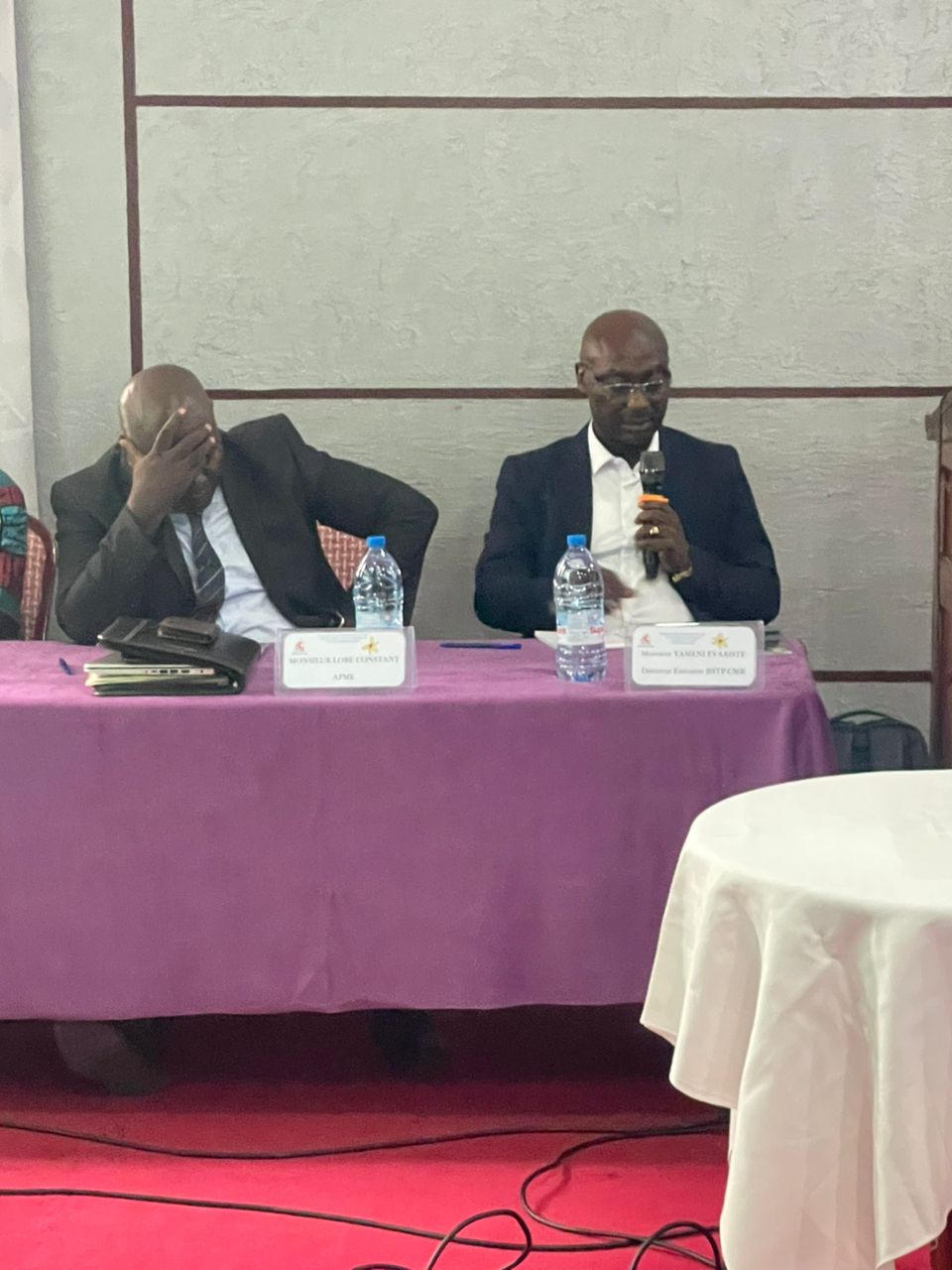
Evariste yameni, the executive director of the bstp-cmr, explains the rationale behind the sensitization seminar on the subcontracting law and the investment code.
Why a sensitization seminar on the Subcontracting Law?
Because at the SPX-CMR, we are aware that no one is supposed to beignorant of the law. However, we all know that many of our fellow citizens are sometimes not fully aware of new laws or the obligations they impose on them. Law N° 2025/010 of July 15, 2025, establishing the subcontracting regime in Cameroon, reconnects all actors involved in subcontracting activity and makes everyone aware of the importance of respecting their commitments. It is about appropriating the law and implementing it in all their professional and contractual acts. This seminar is therefore designed to give SMEs/SMIs, large companies, in short, all participants, the tools to achieve this.
It should also be noted that the SPX-CMR is primarily concerned, just like our members, which are the SMEs/SMIs and large companies. The SPX-CMR was at the fore front of this law and considers it one of its most successful actions.
Can we know more about some elements of the content of this law?
The law establishing the subcontracting regime in Cameroon comprises 69 articles structured around 7 major titles. It defines (I) the general framework for subcontracting, (II) the rules for concluding the subcontracting contract,(III) the conditions for remuneration and the reciprocal obligations of the stakeholders in this regard, and (IV) extends the investment incentives provided for by Law N° 2013/0004 of April 18, 2013, to subcontracting SMEs.
It emerges, among other things, that Cameroonian SMEs have priority in all subcontracting activities. Recourse to a foreign company can only be done after exhausting the directory of local companies and skills. Large companies have the obligation to subcontract 40% of their activities to SMEs, offer them start-up advances of at least 30% of the total amount, andpay for the work performed no later than 90 days after completion.
Subcontracting activity is now regulated by the MINPMEESA, which willcontrol, sanction, reference SMEs, arbitrate disputes, and certify competencies, among other things. Non-recourse to subcontracting, falses ubcontracting, fraudulent maneuvers, undeclared work, refusal to transfer skills, etc., will therefore be systematically sanctioned. This work will bedone, inter alia, with its secular arm, the BSTP-CMR, which has been carrying out the promotion and development of subcontracting activities since its creation.
What role did the BSTP-CMR play in the process that led to this law?
The Subcontracting and Partnership Exchange of Cameroon and its member seach played a decisive role in the process that led to the voting and promulgation of Law N° 2025/010 of July 15, 2025, establishing the subcontracting regime in Cameroon. Placed under the supervision of the Ministry of Small and Medium-sized Enterprises, Social Economy, and Handicrafts(MINPMEESA), the SPX is the secular arm of the State in the promotion of subcontracting.
It is based on this position that the SPX-CMR began to take an interest in the issue of a law on subcontracting and local content in its early days, in2013, and included it in its action plan. The first related activity was the organization of a seminar-workshop on local content on December 6, 2014, at the Yaoundé Congress Palace. The workshop resulted in a series of recommendations, including one related to the establishment of a subcontracting law.
Encouraged by its supervisory ministry, the SPX thus included in its agenda, as its main battle horse, the consolidation of the legal elements necessary to better organize subcontracting and relationships between actors. It systematically mobilized its supervisory authority, its Steering Committee,and its members to achieve this objective.
The SPX multiplied multi-stakeholder meetings, which led to the drafting of a preliminary bill on subcontracting, which was transmitted to its supervisory ministry for further procedures. MINPMEESA, in turn, proceeded with a new review and drafting with high-level experts.
The document continued its journey to the Prime Minister's Office, where it underwent further review in the context of inter-ministerial commissions before reaching the Presidency. It emerged as a draft law for the National Assembly, where it was voted on following the procedure, and then to the Senate, where it was re-examined and voted before its promulgation by the President of the Republic, Paul Biya, on July 15, 2025.
Is everything there, or should we still expect a decree?
Law N°2025/010 of July 15, 2025, establishing the subcontracting regime in Cameroon, has been promulgated. It is already in force and is mandatory forall. It nevertheless contains certain provisions that need to be clarified within the framework of a decree. The latter being an act of the executive power that complements, specifies, or implements a law. The decree details the modalities of its application and sets the technical rules necessary for its implementation. The law establishing the subcontracting regime in Cameroon is therefore a waiting a decree that will clarify some of its provisions.
As was the case with the law, the SPX, under the impetus of its supervisory ministry, engaged in multi-stakeholder consultations the day afterthe law's promulgation to identify the provisions of the law that require clarification or complementary texts. The Subcontracting Exchange has already transmitted what can be considered a preliminary draft decree to its supervisory ministry for further procedures. Given all the commitment and diligence shown by the various actors involved so far, it is not presumptuous to say that the implementing decree is therefore only a matter of time.
What will be the main features of this seminar?
It will involve a global presentation of the law, with an emphasis on specific key points that are important to note. It should be noted that the law establishing the subcontracting regime takes into account almost all actors likely to be involved in a subcontracting relationship: client companies, whether public, private, or foreign partners; Cameroonian SMEs and large companies engaged in subcontracting relationships; and foreign companies within the framework of partnerships or funded projects. It has the particularity of being open to all sectors of economic activity (BTP, mines,hydrocarbons, energy, industry, ICT, services, etc.), as well as national and international structuring projects involving Cameroon.
This law now applies to any subcontracting contract concluded after its entry into force, i.e., since July 15, 2025, and to all public and private contracts, including Public-Private Partnerships (PPPs). These are the points we will insist upon during our discussions.
What should be expected at the end of this seminar?
We are convinced that by the end, participants will have understood this law and will commit to respecting it and enforcing it. The SPX-CMR has produced a magazine of more than 60 pages entirely dedicated to the law, inwhich everything is detailed. The law has been meticulously analyzed.Participants will receive copies and can refer to them in case of doubt. Thisis the very first seminar we are organizing since the promulgation of the law.We will organize several others to raise further awareness.
Your program also includes a presentation and discussion on theInvestment Code. Why? What is the link with the subcontracting law?
We wanted to kill two birds with one stone and thus minimize expenses,but it should be noted that the law establishing the subcontracting regime inCameroon offers several opportunities included in the latest Investment Code.It has also provided for incentive mechanisms and an attractive tax system forthe various actors concerned. It is therefore these advantages integrated intothe Investment Code that will also be presented to participants by an expertwho traveled from Yaoundé for this purpose.


