


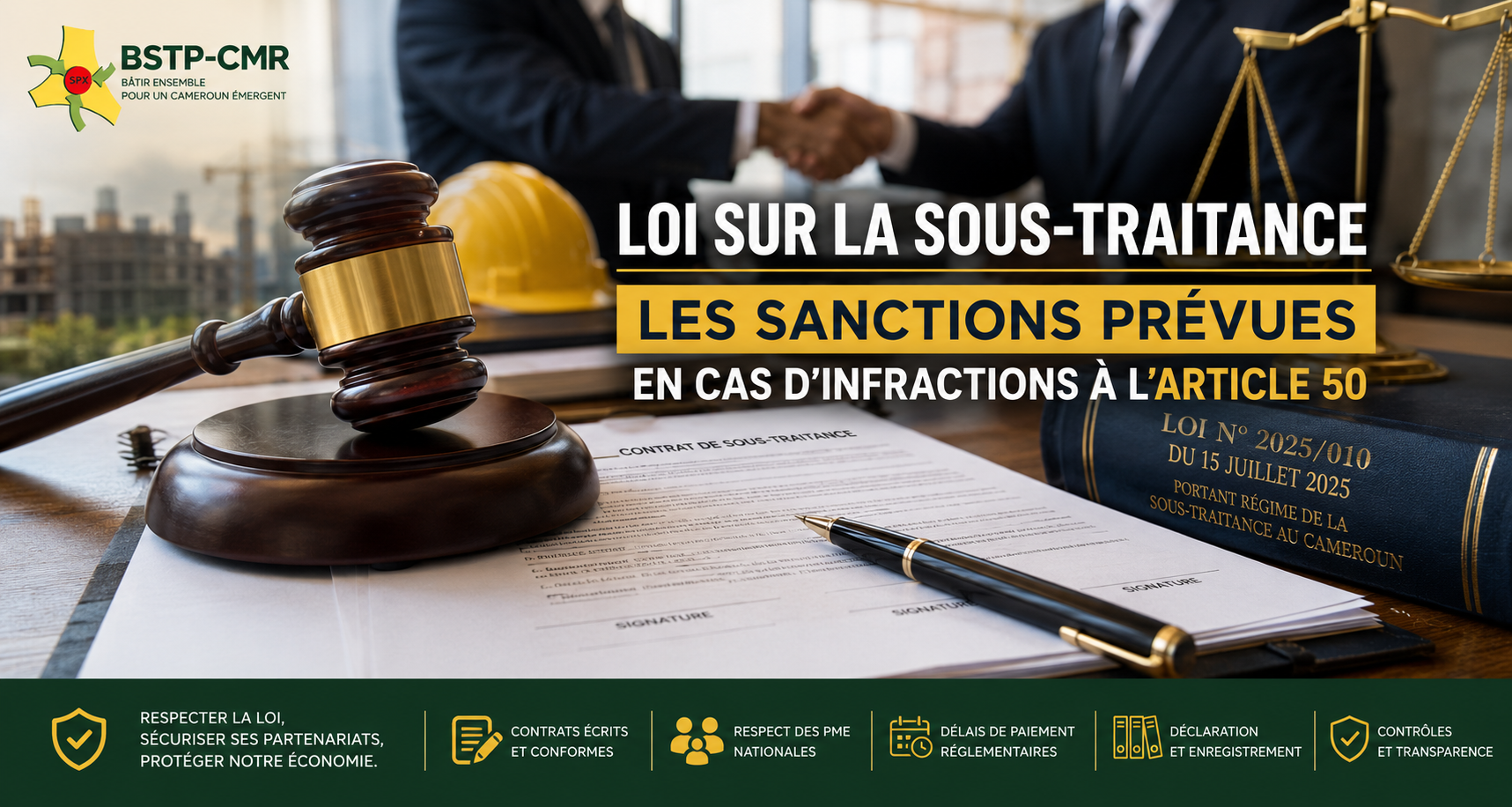
Subcontracting law: penalties for violations of article 50
Like any legislation, the law governing the subcontracting regime in Cameroon provides for sanctions in the event of non-compliance with regulatory texts. Here is an overview of what stakeholders risk in the event of an infringement of Article 50.
Law No. 2025/010 of July 15, 2025, does more than just establish a framework for collaboration; it also sets up a sanctions regime to ensure fairness and transparency within the Cameroonian industry. For member companies of the SPX, understanding Article 50 is crucial to avoiding disputes with heavy consequences.
What constitutes an infringement?
According to Article 50, several behaviors are now classified as offenses, exposing perpetrators to administrative or criminal penalties. Key areas of vigilance include:
- Failure to use written contracts: any subcontracting relationship not formalized by a written contract compliant with legal requirements is considered an offense.
- Absence of mandatory clauses: contracts must imperatively contain the mentions prescribed by law (subject, duration, price, payment terms, etc.). The intentional omission of these clauses is punishable.
- Non-compliance with priority for national SMEs: in certain sectors, the law mandates priority for local SMEs. Ignoring this obligation without valid justification constitutes a direct violation of the legislation.
- Abusive payment practices: failure to meet payment deadlines or applying retention guarantees that do not comply with legal provisions are characterized offenses.
- Failure to declare or register: failing to register a subcontracting contract with the competent authority, when required, is a fault.
- Obstruction of inspections: refusing to provide necessary documents or preventing sworn agents of the Subcontracting Authority from exercising their control missions is heavily sanctioned.
Why vigilance is vital
The legislature has provided these safeguards to protect the national economic fabric. An infringement of Article 50 can lead to:
- Financial fines proportional to the severity of the fault.
- Temporary or permanent exclusion from public procurement or structural projects.
- Suspension of tax and customs benefits that the company might otherwise enjoy.
SPX-CMR advice
To ensure compliance, SPX-CMR recommends that all members audit their current contracts against Law No. 2025/010. Our technical services remain at your disposal to assist you in bringing your subcontracting procedures into compliance.


